
S Corp Illinois: The Complete Guide to Starting One
Starting a business in Illinois means making a big decision early on. An s corp illinois owners can use to save on self employment tax Should you become a sole proprietors
hip, an LLC or an For many small business owners, the S corp is the right middle ground. It offers you the liability protection of a corporation and a tax structure that can put real money back in your pocket.
If you’ve been looking for how to start an s corp in illinois this manual will walk you through each step. You’ll learn what a illinois s corp really is, how to file one, what it costs, what taxes apply, and how to properly shut one down if the time ever comes. So let’s jump in.
What is an Illinois S Corp?
Here’s where most people go wrong. An s corp in illinois is not a different type of business entity. It’s an election you make with the IRS for federal tax. In Illinois, you need toestablish a real legal entity before you can choose S corporation status. That means forming a generic LLC or corporation with the Illinois Secretary of State.
Once that entity is in place, you file paperwork with the IRS asking to be taxed under Subchapter S of the Internal Revenue Code instead of the default corporate tax rules. That election is what makes your Illinois corporation a s corp illinois business owners refer to when talking about tax savings.
The main attraction is pass through tax. Profits and losses are taxed only once, on your personal tax return, rather than twice—once at the corporate level and again when you pull the money out. Also, S corp owners who work in the business can divide their income between a fair wage and other distributions. For many owners, the real savings is in the Social Security and Medicare tax, which is only on the salary portion.
Why Form a S Corp in Illinois
Before you get into the paperwork, it helps to know why so many small business owners prefer this structure over a plain old LLC or sole proprietorship.
Lower self-employment tax.
Payroll tax is on your salary, not on your whole profit.
Protection of personal assets.
Your personal assets are protected from business debts and lawsuits in the same manner as any corporation.
Trust with banks and clients.
A formal corporation can help with obtaining financing or securing larger contracts.
Straight pass through taxation.
You pay your personal return on the profits. This avoids the double taxation of regular C corporations.
But none of that happens automatically. You still have to do the right thing with the IRS, and the state.
How to Start an S Corp in Illinois Step by Step
If you prefer professional assistance, our S Corp formation services can help you with the formation process and S Corp election requirements.
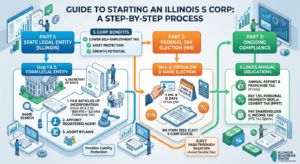
If you’re ready to take the next step, here is exactly how to start an s corp in illinois from scratch.
Step 1: Pick and Check Your Business Name
Your name must be different from other businesses already registered in Illinois. Before you file anything, you can check the Illinois Secretary of State’s business database for name availability.
Step 2: File Articles of Incorporation
This is the heart of how to form a s corp in illinois. You will file Form BCA 2.10, Articles of Incorporation, with the Secretary of State of the State of Illinois. This document will contain your corporate name, registered agent, amount of authorized shares, and incorporator information. The base filing fee is a flat $150.
You also owe an Initial Franchise Tax, separately, calculated at $1.50 per $1,000 of paid in capital, with a $25 minimum. That minimum applies to most small businesses with a standard starting capital of less than $16,666, bringing the total state cost to $175, the $150 filing fee plus the $25 minimum franchise tax. Illinois also tacks on an expedited processing fee on top of that if you file electronically through the Secretary of State’s portal.
Step 3: Choose a Registered Agent
All Illinois corporations must have a registered agent with a physical Illinois address. This person or business is where your business’s legal and government documents are sent to.
Step 4: Obtain an EIN from the IRS
You will need your EIN to open a business bank account, hire employees, or file the S corp election. You can file directly on the IRS website, free of charge.
Step 5: Write Bylaws and Organize the Corporation
Bylaws are the rules that govern how your corporation will operate internally. They cover things like how directors are elected and how meetings will be run. At the organizational meeting you will formally elect directors, issue shares to the shareholders and adopt bylaws.
Step 6: File IRS Form 2553 for S Corp Election
This is the step that actually makes it a illinois s corp for the purposes of taxation. If you do not make this filing, your business’s default tax status is that of a regular C corporation.
Step 7: Register with the Illinois Department of Revenue
You will need to register your business with the Illinois Department of Revenue using MyTax Illinois to satisfy state tax obligations, including the replacement tax discussed below.
How to Change an Illinois LLC to a S Corporation
Many business owners already have an LLC and want to know how to create a s corp in illinois from scratch. The good news is you don’t have to dissolve your LLC. If the LLC qualifies under the rules for S corp taxation, it can elect to be taxed as a S corp by filing Form 2553 with the IRS. Your LLC is still an LLC in the eyes of the state. For tax purposes, the IRS treats it like a S corp. This is one of the most common avenues small business owners take as it avoids the cost and hassle of creating a brand new corporation.
What You Should Know About S Corp Taxes in Illinois
Many new owners are caught off guard with their state of illinois s corp tax obligations. S corporations are exempt from the regular Illinois corporate income tax. Instead, they pay something called the Personal Property Replacement Tax, or PPRT.
Here’s a breakdown of the rates in Illinois:
- The standard corporate income tax of 7 percent is topped up with a replacement tax of 2.5 percent for regular corporations.
- Instead, S corporations, partnerships and trusts pay a 1.5 percent replacement tax on their net Illinois income.
Your S corp will file Form IL-1120-ST, Small Business Corporation Replacement Tax Return. Usually this is due March 15 for calendar year businesses.
Illinois has a Pass Through Entity Tax, or PTE Tax that is 4.95 percent. This lets an eligible s corp illinois business pay state income tax at the entity level, rather than passing it through to each shareholder’s personal return. That’s important because it’s a state level workaround for the federal $10,000 cap on the State and Local Tax, or SALT, deduction. The direct deduction of the state tax as a business expense on Form 1120-S can greatly reduce net federal taxable income for shareholders. Depending on your particular numbers, this election makes sense so it’s worth talking to a tax professional before you opt in.
Remember, in addition to the replacement tax, your individual shareholders still report their share of income on their personal Illinois tax returns, and payroll taxes still apply to any salary the corporation pays its owner employees.
How to File for S Corp in Illinois (IRS Form 2553 Details)
Basically, learning how to apply for s corp in illinois status is just a matter of knowing the federal election process, because Illinois doesn’t have its own S corp application at the state level.
To qualify your business must meet these requirements:
- Must be a corporation or LLC located in the United States.
- No more than 100 shareholders.
- Have one class of stock.
- Be owned by individuals, certain trusts or estates, not partnerships or corporations.
- Have US citizen or resident alien shareholders.
Here the timing is very important. Generally, you must file Form 2553 no later than two months and fifteen days after the beginning of the tax year for which you want the election to apply. If you miss that window you may have to wait until the following tax year, although relief for late election is sometimes available if you have reasonable cause for missing the deadline.
How to Dissolve a S Corp in Illionis
Some businesses close, merge or restructure and owners need to know how to dissolve a s corp in illinois the right way. If you don’t dissolve properly, you may still be on the hook for recurring state fees and tax filings even if the business has ceased operating.
The general process is as follows:
- Obtain formal authorization from your board of directors and shareholders to liquidate.
- Prepare and file Articles of Dissolution with the Illinois Secretary of State on the appropriate BCA form.
- Notify the Illinois Department of Revenue and pay any past-due replacement tax or payroll tax.
- File a final federal tax return with the IRS, making sure to check the box indicating it is a final return.
- Once you’ve done all that, close your EIN account with the IRS.
- Notify creditors, close local business bank accounts, and cancel any local licenses or permits.
If you want to specifically revoke the S election, but keep the underlying corporation active, that requires a separate written statement filed with the IRS. This is different from dissolving the entire business.
Common Mistakes to Avoid
There are a number of mistakes that keep showing up with new S corps in Illinois.
- Missed the Form 2553 deadline. It’s the No. 1 reason business owners end up taxed as a C corporation for a year they didn’t want to be.
- Paying an unreasonable salary. The IRS expects business owners to pay themselves a reasonable salary before taking distributions, the IRS said. Avoiding payroll tax by paying an inadequate salary is a common audit red flag.
- Illinois Replacement Tax. Sometimes owners think that, due to the federal pass through treatment, there is no state level entity tax at all — this is not the case in Illinois.
- Not following corporate formalities. Not having annual meetings, keeping minutes, or mixing personal and business funds can jeopardize your liability protection.
FAQs
How do I set up a S corp in Illinois?
You form a corporation or LLC with the Illinois Secretary of State, then submit Form 2553 with the IRS to elect S corp tax treatment.
How do I dissolve a S corp in Illinois?
You file Articles of Dissolution with the Illinois Secretary of State, pay any outstanding state and federal taxes, and file a final tax return marked as such.
How to change an LLC to a S corp in Illinois?
You can elect to have your existing LLC be taxed as a S corp by filing IRS Form 2553, without the need to dissolve or reform your LLC.
What is the process to obtain S corp status in Illinois?
You file IRS Form 2553, usually within two months and fifteen days of the start of the tax year you want the election to apply to.
How to create a S corp in Illinois?
The main steps to creating one are filing Articles of Incorporation with the Illinois Secretary of State, obtaining an EIN and then filing the federal S election.
Conclusion
Setting up a s corp illinois that business owners can count on for tax savings takes a bit more paper work than a basic sole proprietorship, but the payroll tax savings and liability protection make it worth it for many growing businesses. If you’re just learning how to start a s corp in illinois or you own an LLC and want to know how to create a s corp in illinois through a S election, the process is manageable when broken into steps.
If you are not sure about payroll setup, reasonable salary calculations or the Illinois replacement tax filing, it is worth talking to a bookkeeper or CPA before you file. Get the structure right from day one. It pays dividends.