
S Corporation Bookkeeping: How to Stay Compliant and Organized (A Complete Guide)
There are real tax advantages to running a S corporation, but only if your books are clean. S corp bookkeeping is not the same as bookkeeping for a sole proprietorship or a regular LLC. There are other rules around payroll, distributions, and shareholder basis that if you don’t follow, can threaten your status as a S corp. In this guide, we’ll walk you through everything you need to know about bookkeeping for s corp entities, from the basics to the more advanced compliance issues that trip up a lot of business owners.
Why S Corp Bookkeeping Is Different
Choosing S corp status means that you’re telling the IRS that the income from your business will flow through to your personal tax return, avoiding the double taxation that C corporations have to deal with. There are strings attached to that benefit. The IRS expects that any shareholder working in the business be paid a reasonable salary, that distributions are properly tracked, and that records of shareholder basis be accurate. So s corp bookkeeping is a little more careful than just a cash in, cash out ledger.
Too many small business owners think that because they are the only shareholder they can move money in and out of the business account at will. That assumption runs into trouble quickly. Without strict bookkeeping for s corp structures, you run the risk of having distributions reclassified as wages which can lead to back payroll taxes, penalties and interest. https://www.irs.gov/businesses/small-businesses-self-employed/s-corporations
Critical Elements of S Corp Bookkeeping
1. Separate Your Business and Personal Finances
This sounds obvious, but it is by far the most common mistake. Your S corp needs to have its own bank account, its own credit card, and its own set of books. Mixing personal and business transactions makes s corp compliance bookkeeping nearly impossible. Mixing the two can also pierce the liability protection you are supposed to get from your corporate structure.
2. Shareholder Employee Payroll
When you’re an employee of your S corp, the IRS expects you to pay yourself a reasonable salary through payroll before taking any distributions. This salary needs to be processed through a proper payroll system with social security, medicare and income tax withholding. Not doing payroll and just taking distributions is one of the fastest ways to get audited. Good s corp bookkeeping requirements always start with getting payroll set up correctly from Day 1. https://www.irs.gov/businesses/small-businesses-self-employed/s-corporation-employees-shareholders-and-corporate-officers
3. Tracking Distributions Separately from Wages
Distributions are the profit you take out of the business in addition to your wages. These should be on their own account in your chart of accounts, separate from payroll expenses. When you are dealing with s corp bookkeeping, this separation is not optional. It is the line most closely scrutinized by the IRS when auditing S corp returns.
4. Shareholder Basis Tracking
Basis is the amount of money you have invested in the business, and is adjusted each year for income, losses, and distributions. A lot of bookkeepers miss this because it is not on a standard balance sheet. But basis determines if your losses are deductible and if your distributions are taxable. This is an important part of s corp compliance bookkeeping often missed by bookkeepers who are used to working with simpler entity types.
5. Monthly Account Reconciliation
Reconcile your bank and credit card accounts on a monthly basis, not once a year at tax time. That’s how mistakes are made when you wait until tax season to put together twelve months of transactions. Any actual bookkeeping process improvement s-corp owners can rely on is key to a monthly cadence, and it takes a lot of the stress out of tax filing.
Frequent Bookkeeping Errors
Even the best-intentioned business owners encounter the same handful of problems.
- They don’t have any payroll at all and just pay themselves distributions
- Mixing personal and business expenses (e.g. using your personal account for business expenses and vice versa)
- Misclassification of the shareholder loans
- No year to year basis tracking
- Waiting until the end of the year to balance books
When bookkeeping process improvement s-corp consultants come into a messy set of books, the first thing they do is fix these issues. The good news is that most of these problems are fixable with the right systems in place and they seldom require starting from scratch.
How to Do Bookkeeping for a S Corp: A Step by Step Manual
If you are looking for how to bookkeep for s corp structures the right way, here is a very practical framework.
Step one: Create a separate chart of accounts. Your chart of accounts should separate shareholder wages, shareholder distributions, shareholder loans and retained earnings. This structure is the foundation for accurate s corp bookkeeping.
Step two: Run payroll consistently. Pick a payroll provider that automatically withholds and files taxes. You’ll keep yourself compliant, reduce your audit risk, and get paid a fair, moderate salary through payroll every pay period.
Step three: Record distributions as they occur. If you withdraw profits from the business for personal use, record the withdrawal as a distribution immediately, not as an expense.
Step four: Reconcile monthly. Each month, ensure your books and bank statements add up so you don’t miss anything.
Step five: Update shareholder basis at year end. Get with your accountant to adjust basis for the year’s income, losses and distributions before you file.
The real answer to how to bookkeep for s corp owners who want to avoid tax time surprises is to consistently follow this process.
Are the Bookkeeping Requirements the Same for S Corps and C Corps?
One of those questions a lot of new business owners ask, and the honest answer is no. Are the bookkeeping requirements the same for s and c corp entities? Not completely. C corporations are subject to double taxation, so their books must include the corporate level income tax in addition to any dividends paid to shareholders. S corps pass income through to shareholders, so your bookkeeping needs to be focused on accurately tracking pass through income, shareholder wages, distributions, and basis.
Both are required to keep business and personal finances separate and both need proper payroll if the owner works in the business. But the specific compliance items, particularly related to basis and distributions, are unique to S corps and are not carried over from C corp bookkeeping practices.
Is It Possible for a Bookkeeper to Operate as a S Corp?
So here’s a question that pops up more than you might think: can a bookkeeper be a s corp? Yes. Many independent bookkeepers form their own businesses as S corporations to take advantage of the same pass through taxation and self employment tax savings other small business owners benefit from. A bookkeeper who chooses to be a S corp in their own practice has to follow the same rules above, including paying themselves a reasonable salary and tracking distributions separately.
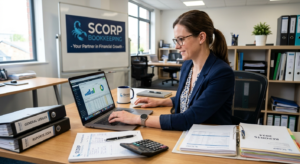
If you are hiring a bookkeeper for your S corp this is a good sign actually. A bookkeeper who runs his or her own S corp business will often have first-hand experience with the very compliance issues your business is facing, which can make them a better fit for your needs.
How Does a S Corp Deduction Appear in LLC Accounting?
Another common question is, some business owners have an LLC with a S corp tax election. What does an s-corp expense look like on llc bookkeeping? In practice, it looks pretty much the same as a S corp expense. The legal structure is still an LLC, with bookkeeping under S corp rules instead of default LLC rules once the S corp election is made.
That means shareholder wages still have to go through payroll, distributions still have their own tracking category, and basis still has to be calculated each year. Under S corp taxation, the LLC chart of accounts should be similar to what you would set up for a traditional S corp, with wages, distributions and expenses clearly separated out. The only real difference lies in the legal paperwork and liability structure, not the day to day bookkeeping entries.
Building Better Habits for S Corp Bookkeeping
Good s corp bookkeeping doesn’t have to be complicated software. It’s about consistency. Select a regular monthly time to reconcile accounts, review payroll, and check that distributions are properly logged. Small, consistent habits spare you the end-of-year rush that causes mistakes in your tax return.
It can also make all the difference to work with a bookkeeper or accountant that specializes in S corps. Someone with specific experience in s corp compliance bookkeeping will know exactly what the IRS wants and can help you set up systems to flag problems before they become costly mistakes.
For help keeping your books organized and preparing your S Corp return correctly, explore our S Corp tax preparation services.
Summary
S corp status can mean big tax savings, but only if the books behind it are solid. Every piece counts, from creating the right chart of accounts, to running consistent payroll, to tracking shareholder basis. Whether you are managing s corp bookkeeping requirements on your own or using a professional, the goal is the same: accurate records that keep you compliant and give you a clear picture of how your business is really doing.
The time you put in now to build good bookkeeping for s corp habits will pay off in time, money and stress saved when tax time comes around. To get it right, you need consistency, separation of accounts and attention to the details specific to S corps.