
S Corp vs C Corp: Which Structure Is Right for You
Choosing a business structure is paperwork until the first tax bill arrives. Then it gets very serious. Almost every founder who incorporates in the United States has to make the s corp vs c corp decision, and the right answer depends on how much profit you make, how many owners you have, and whether you plan to raise outside money.
This guide takes a simple approach to explain the tax treatment, the ownership rules, the paperwork, and the particular situations where each option wins. No jargon dumps, just the stuff that really matters in what you hold at the end of the year. if you decide on forming an s corp here you is the link https://haaditaxandaccountants.com/s-corp-formation/
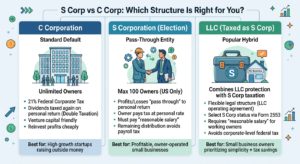
First, What Is S Corp and C Corp?
If you’ve been thinking about what is s corp and c corp, the short answer is: neither of those are a type of company you register at the state level. Both are federal tax classifications that are layered on top of a corporation you’ve already formed.
You have a corporation when you file articles of incorporation with your state. The IRS automatically treats that corporation as a C corporation, named for Subchapter C of the Internal Revenue Code. If you’d like different tax treatment, you fill out form 2553 and elect to be a S corp, named after Subchapter S.
This one detail resolves most of the confusion. You are not comparing two different companies. You are deciding how the same company should be taxed.
An LLC can also elect to be taxed as a S corporation and that is where a lot of small business owners find themselves. The LLC retains its flexible legal structure and just changes how the IRS views its profits.
The Main Difference Between C Corp and S Corp
The biggest difference between s corp and c corp is where the tax bill goes.
A C corporation pays taxes on its earnings at the corporate tax rate of 21 percent (federal). If the company then pays some of those after tax profits out to shareholders as dividends, the shareholders pay tax again on their personal returns. That second layer is what people call double taxation.
An S corporation is a pass-through entity. The business itself doesn’t pay federal income tax. The profits and losses are passed through to the shareholders who report them on their personal returns and pay tax at their rates. The company files an informational return (Form 1120-S) and issues each owner a Schedule K-1.
Here’s the same idea, but with numbers. Let’s say your business makes a profit of 200,000 dollars.
The company pays 21 percent, or 42,000 dollars, under C corp treatment, leaving 158,000 dollars. If you pay out all of it in a qualified dividend at 15 percent, that will be another 23,700 dollars. The tax in total is about $65,700.
The 200,000 dollars flows through to your personal return as S corp treatment. You’ll pay ordinary income tax on it and may be eligible for the 20 percent qualified business income deduction, which could greatly reduce the taxable amount. Many owners come out ahead at this level of profit.
That gap is why the c corp vs s corp question is so important for profitable small businesses that pay out most of their earnings.
Reasonable Salary Rule & Payroll Taxes
The s vs c corp comparison is more interesting than a simple tax rate matchup because of one wrinkle.
If you have a S corp and work in the business, the IRS requires you to pay yourself a reasonable salary. That salary is subject to payroll taxes, currently 15.3 percent combined for Social Security and Medicare up to the wage base. Above your salary, excess profit shares are not payroll taxed.
This is the old S corp savings game. An individual earning $150,000 could pay themselves a salary of $80,000 and then take $70,000 as a distribution, thereby not paying payroll tax on that latter amount. The savings can be five figures a year or more.
The word reasonable is the problem. If you make your salary artificially low, you invite an audit. The IRS looks at what people in similar jobs make in your industry and area, your responsibilities, your hours and how much the business brings in. There is no magic percentage, but many accountants will start the conversation with a 60 percent salary and 40 percent distribution split.
C corp owners who work in the business are employees. They receive a salary, payroll taxes are withheld by the company and that salary is a deductible business expense that lowers the company’s taxable income.
Ownership Rules: When Restrictions Backfire
The tax code has written hard restrictions for S corporations:
- Not more than 100 shareholders
- Shareholders may be US citizens and resident aliens
- Only one class of stock is permitted
- Partnerships, companies and most trusts are not permitted to hold shares
- The entity must be a domestic corporation
C corporations don’t have any of those limitations. Unlimited number of shareholders. Foreign investors allowed. Multiple classes of stock permitted. Other companies can own stock.
That’s why nearly every venture-backed startup is a C corp. Venture funds are often structured as partnerships and therefore cannot be S corp shareholders. Funds expect preferred stock with liquidation preferences and protective provisions too, and that takes more than one class of stock. An S corporation cannot do this.
So if your five year plan has a priced round in it, then the difference between s corp and c corp is not a tax conversation anymore, it’s a fundraising conversation.
Can a C Corp Own an S Corp?
This comes up all the time in holding company planning so it deserves a straight answer.
Can a c corp own an s corp? Clean no. Corporations cannot be S corporation shareholders. If a C corp buys shares in a S corp, the S election ends immediately and the company becomes a C corp again.
Some related points worth knowing:
An S corp can own a C corp. The restriction is one-way, so a S corporation can freely hold stock in a C corporation subsidiary.
An S corp may own a qualified subchapter S subsidiary, called a QSub. A QSub is a wholly owned S corp that is treated as part of the parent for tax purposes.
An S corp can own an LLC. Single member LLCs owned by a S corp are generally treated as disregarded entities.
It is possible for an individual to own a C corp and a S corp separately. The ban is on the corporation holding the shares, not the human being behind both.
If you’re constructing a multi entity structure, plot out the ownership chain with a tax advisor before filing anything. Accidental S election terminations can be difficult to undo, and sometimes require a private letter ruling from the IRS to fix.
Retained Earnings and Reinvestment
And there is one situation where the C corp wins, and it’s overlooked because the double taxation headline is so loud.
Double tax only applies if you take profits out of the company. If you put all that back into inventory, equipment, hiring, research, the second layer never happens. Your profits are in the business. They get taxed once at 21 percent.
Now consider the S Corporation where the profits flow through to your personal return regardless of whether you actually take the cash out. An S corp owner in a high tax state can be hit with a big personal tax bill on money that is still sitting in the company bank account. That’s called phantom income and it’s a real cash flow problem for fast growing businesses.
Deductions and Fringe Benefits
C corps get better treatment on owner benefits.
A C corporation can deduct the cost of health insurance, life insurance (within limits), disability coverage and other fringe benefits for owner employees, and those benefits generally are not taxable to the recipient.
There is a different rule for S corp shareholders who own more than 2 percent of the company. The company pays the health insurance premiums, which are added to the shareholder’s W-2 wages and then deducted on the personal return. The net result is usually similar but it is messier and some benefits are not given the same tax free treatment.
C corps can also utilize the Section 1202 qualified small business stock treatment. If you hold QSBS for five or more years and the company qualifies, you may be able to exclude a substantial portion of your capital gain on sale. That’s a meaningful exit-planning benefit that S corp shareholders don’t get. It’s another reason why the c corp vs s corp discussion should be about your eventual exit, not just this year’s return.
State Taxes Change the Equation
Federal rules are identical. State rules aren’t.
Some states don’t recognize the S election at all and tax the entity anyway. Some charge franchise taxes or minimum fees regardless of your federal classification. For example, New York City does not recognize S corp status for purposes of the city’s general corporation tax. California imposes a franchise tax of 1.5 percent on net income for S corps, with a minimum annual amount.
If you operate in multiple states, the pass through nature of a S corp also means filing personal returns in each state where the business has nexus. The paper work adds up quickly.
Always run the s vs c corp comparison in the model with your particular state and city. A structure that is cheap in Texas costs money in New York. For more info on C corp visit irs https://www.irs.gov/businesses/small-businesses-self-employed/forming-a-corporation
Compliance & Paperwork
Both require corporate formalities: bylaws, a board of directors, annual meetings, minutes and a separate business bank account. Neither is a casual thing.
S corps provide ongoing surveillance. Watch shareholder eligibility. Make only 1 class of stock. Write down your reasonable salary. Start payroll from the beginning. The election can terminate if a single ineligible shareholder acquires stock.
C corps include the corporate return, Form 1120, tracking basis and dividend distributions. And for companies with investors, there’s also cap table management, 83(b) elections and 409A valuations to deal with.
So Which Should You Choose? S corp vs C corp?
In practice, here’s generally how the s corporation and c corporation works.
S corps tend to fit if you have a profitable business, a small number of US-based owners, distribute most of your earnings to yourself, your profit is comfortably above your reasonable salary and you’re not planning to raise venture capital.
A C corp is usually the best option if you want outside investors or foreign shareholders, if you want to reinvest profits instead of distributing them, if you want multiple classes of stock for employees and investors, if you want maximum deductible benefits, or if you are planning for a future acquisition where QSBS treatment could be important.
The honest answer to the question of c corp or s corp for your business comes down to numbers only you and your accountant can know. Run both scenarios using actual projections before you file.
Can You Change Your Mind Later?
Yes, with limitations.
To change from C corp to S corp, you file Form 2553, generally within two months and fifteen days of the beginning of the tax year for which you want it to be effective. Beware of built-in gains tax on appreciated assets sold within five years of conversion.
To convert from S to C corporation, the election is revoked with the written statement and shareholder consent. Once you revoke, the IRS generally does not permit a re-election to S status for five years.
Startups might begin as an LLC taxed as a S corp for the first profitable years, then convert to a C corp when a funding round is on the horizon. That path will work, but the conversion has tax consequences so plan it out versus winging it.
Conclusions
People treat what’s the difference between s corp and c corp as if there is one right answer just waiting to be found. There isn’t. There is only the structure that fits your profit level, your ownership, your state, and your 5 year plan.
S corp usually saves money for profitable owner operated businesses that pull cash out. C corps are usually where companies that are raising capital or reinvesting heavily fall. The rest of it is a serious modeling session with a CPA who is going to be looking at your actual numbers.
Get your structure right early. You can fix it later but it will cost more than doing it right the first time.